Do you have a contracting business that receives a lot of work but never seems to have enough cash to reflect your consistent flow of projects? Are you struggling to improve contractor profits despite taking on numerous clients or projects? Like others in your position, you may think the issue is simply a major cash flow problem, but the problem may be estimating mistakes that contractors make.
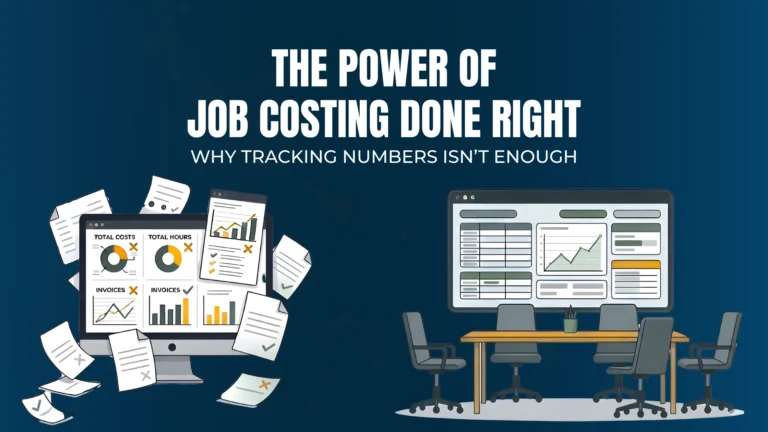
The assumption is that projects lose money after the work is over. However, in many instances, the profits are already lost in the estimate. Inaccurate job costing can lead to a domino effect known as the fatal triangle.
Consider the information below to learn about the fatal triangle and how to overcome it and improve your business’s profitability.
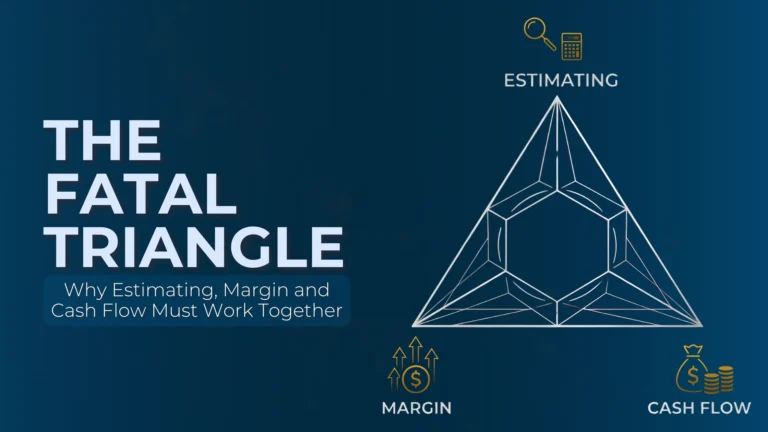
What Is the Fatal Triangle?
In simple terms, the fatal triangle refers to a business’s cost estimates, margin, and cash flow. It’s important not to overlook the importance of their connection. Otherwise, you could experience everything from labor cost miscalculations to a lack of cash on hand.
So, how does it work? All of your estimates should reflect your projects’ real costs. Inaccurate job costing can lead to poor margin calculations, which directly impacts your cash flow.
Let’s take a closer look at each factor.
Inaccurate Cost Estimates

One of the top estimating mistakes contractors make is inaccurate job costing. The estimate for a project shouldn’t be just a number on paper. It’s the entire project’s foundation that influences both your ability to manage overhead and earn a profit.
Direct job costs like materials, labor, equipment, and subs are essential for accurate estimations. However, you must also consider indirect costs, such as:
- Mobilization
- Overhead
- Labor burden
- Waste factors
These indirect costs will always be present, regardless of the projects you accept. When you build your estimates to factor in all expenses and include the full scope of the project, you’re more likely to be accurate in your job costings. You need accuracy to improve contractor profits.
Margin Errors
Many contractors, unfortunately, confuse markup for margin, so they treat them the same. However, doing this can result in lost profit.
Suppose you estimate a project’s costs to be $50,000 and you mark it up by 20%. You may think you created a 20% margin, but the markup actually created a 16.7% margin. This may seem like a small mistake, but if you consistently make it, the costs will add up significantly.
It’s not unusual for contractors to lose money from a single mistake. However, many don’t see the profits they expect to have from all the work they complete due to poor margin calculations. Even when jobs look profitable in theory, you need the math to back it up.
Lack of Stable Cash Flow
The last aspect of the fatal triangle is cash flow. You could have an accurate job estimate, hit your margin, and still be short on cash after a major project. So, why does that happen?
The issue may be due to you financing the job instead of the client. In other words, you handle your payroll and pay suppliers and subcontractors according to a set schedule. Yet, your client only pays according to the project’s contract.
When you have more cash going out than you have coming in, you will feel the strain. It’s important to understand that consistent cash flow issues typically develop due to a series of earlier decisions and calculations during the pricing and estimating stages.
Tips for Improving Contractor Profits

How can you avoid these common estimating mistakes contractors make? Here are tips to address each part of the fatal triangle.
Learn How To Estimate Everything Fully
Accurate estimations are the cornerstone of your efforts to improve contractor profits. When job costing, ensure that you include every real cost of running your business, as well as the direct expenses of your project.
Never neglect to incorporate your operational costs into the job’s direct expenses. It would be challenging to meet your profit goals if you fail to calculate the estimate up front.
Calculate Margin Efficiently
Next, you must ensure that you calculate the margin correctly to avoid minor miscalculations that add up over time. The formula is the cost divided by one minus your margin. When you make your pricing using this formula, you will have a more predictable margin, which increases your profits.
Create a Schedule for Payments
Finally, you want to create an effective payment schedule. The goal here is to generate enough cash flow to support your business and all of the direct and indirect expenses. If you don’t have enough cash coming in from jobs consistently, despite being busy, the funds you need to complete your work and manage your operational costs will dry up more quickly than expected.
Look at it another way. Deposits fund the project at the beginning. Progress payments keep cash coming in while the final payment protects the profit.
Arranging the payment schedule is only half of the work. You also need to review your finances weekly to ensure that the schedule is doing what it needs to do. That means you should conduct budget checks, review schedule assessments, and revisit your cash expectations each week.
Taking a proactive approach to cash flow management instead of waiting until the end of the month or after a project concludes helps you catch potential problems early. The sooner you uncover issues, the faster you can correct them.
The Bottom Line
Everything from poor change order management to routine material cost fluctuations can impact your bottom line. That’s why job estimates should reflect your business’s real costs. Inaccurate estimates could lead to profit margin erosion, which ultimately affects your cash flow.
You don’t have to deal with the fatal triangle alone. Take a step toward consistent profitability and avoid the common estimating mistakes contractors make by reaching out to Susan Giddings Consulting LLC. I help contractors and construction firms turn their busy businesses into predictable, profitable ones, so call (561) 389-2609 to schedule a consultation.