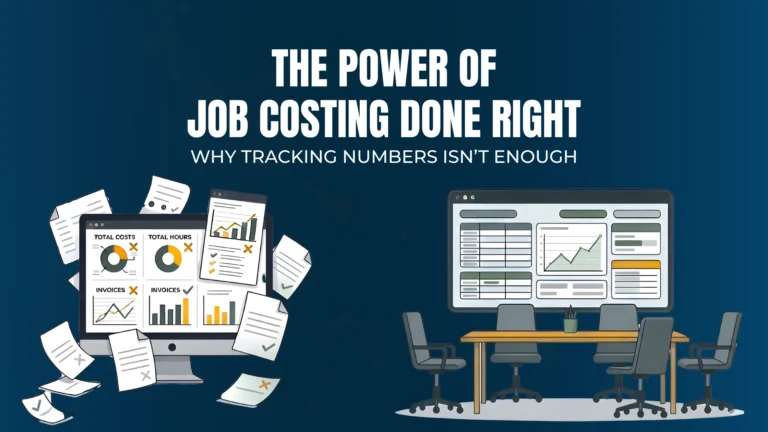
Job costing for contractors is one of the most important systems for protecting profit on construction projects.
Many contractors and construction firms share a similar frustration. After accepting a job, generating a reasonable estimate for the work, and completing the project, you expect a commensurate profit. However, the funds you see on paper aren’t in your bank account.
So, what happened? Ineffective contractor and construction job costing is the likely issue.
Job costing tracks various expenses to determine project profitability. Unfortunately, many professionals don’t understand how to connect job estimates with actual profit, and it costs them thousands.
Keep reading to learn about common issues with job costing for contractors and how to overcome them.
The Connection Between Actual Job Costing and General Estimating
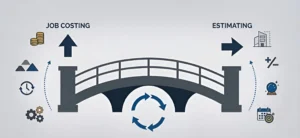
Construction companies and contractors often view job costing as end-of-the-job paperwork instead of something to do before and during a project. If you wait until the work is over to determine how much profit you earned, chances are, most or all of the money will already be gone.
Builders often assume that being busy with work is the same as being profitable, but that isn’t always the case. Tracking everything from overhead expenses to labor cost allocation is necessary, yet such data only tells you half of the story. To accurately estimate jobs that should be profitable, you need to understand what happened as well as why it happened.
Construction job costing isn’t only about recording a project’s total hours and invoices. It’s also about factoring in problems that may arise and could eat into your profits. Something as minor as a shipment delay of vital materials can throw off estimates and impact your bottom line.
Job Costing Problems Contractors and Construction Companies Encounter
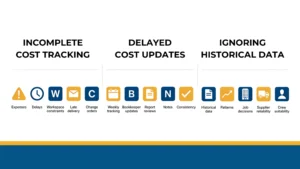
Builders usually make three specific mistakes when managing job costing for contractors.
Problem 1: Tracking Costs Without Supplemental Information
No two projects are exactly the same, and unforeseen issues could develop at any time. If you only track expenses and don’t include why the actual numbers differ from estimates, you might accept a similar job in the future without fully understanding how it could negatively impact your bottom line.
For example, let’s say that, during the second week of a project, unforeseen delays resulted in the loss of two days of work. Then, your crew had to work more slowly than usual in the third week because of workspace constraints. To top it all off, during the fourth week of the project, there was a late delivery and an unfulfilled change order for extras that the client requested at the last minute.
These situations can add up to a big problem when it comes to your profit. Yet, you wouldn’t know unless you carefully recorded them as part of your job cost tracking.
With job costing, it’s important to take notes because they provide essential information that can help you make more accurate estimates for future jobs. The numbers tell you what happened, while the notes tell you why it happened. Without the extra information, you could keep encountering similar issues and not realize it until it’s too late.
Problem 2: Not Tracking Costs Weekly
As previously mentioned, construction job costing isn’t a task you complete at the end of a project. Embracing a weekly tracking system is a more efficient way to earn actual profit from your jobs. By waiting until after you complete a project to review your costs, you lose the opportunity to change anything that’s gone wrong before it becomes a costly mistake.
Weekly job costing allows you to catch overruns early and ensure efficient material cost management. For instance, you can adjust your crew count as needed and issue change orders in real time. This type of tracking puts you in control of your expenses and profits.
Consider this system to put your weekly tracking into practice:
- Update actuals weekly: Your bookkeeper should update expenses for every job each week. That information should include everything from hired subcontractors to equipment.
- Review reports: Create a standing weekly appointment with your foremen or project managers to review the reports for each job. This time is ideal for uncovering potential slowdown issues, discussing change orders, and addressing other concerns.
- Add notes: Take time to document why things happened, whether positive or negative, to generate data.
- Stay consistent: Turn weekly job costing into a habit to avoid looking solely at numbers. Numbers and notes work together to protect your profits.
Problem 3: Overlooking the Importance of Historical Data
Another major issue with contractor job costing is not understanding how to use cost tracking to build the data that ensures more accurate estimations. Tracking your expenses and taking weekly notes on why costs are more or less expensive than estimates generates historical data for your business. This way, you don’t have to rely on industry averages or guesses.
The more historical data you generate, the more patterns you see in your work. You can use this information to run your business more efficiently by doing the following:
- Make better decisions on the types of jobs to accept and which to turn down.
- Learn which suppliers are unreliable and cause shipping delays.
- Determine which crews are more suitable for specific project types.
When it comes to construction job costing, it’s crucial that you create historical data instead of relying on industry norms. Detailed job costing uses your business’s actual data, which makes your estimations more accurate over time. You learn how long things take under your work conditions, as well as your actual material usage.
Enjoy Consistent, Accurate Cost Estimations With Reliable Job Costing
You don’t have to settle for reactive job costing that can cause you to lose thousands of dollars. By learning how to leverage construction job costing the right way, you can begin seeing consistent profits instead of unexpected losses.
Ready to take the next step and see evidence of your work on paper and in your bank account? Reach out to Susan Giddings Consulting LLC today at (561) 389-2609 to learn more about job costing for contractors and add more funds to your bottom line.